
Lakewood Previous Residents Sources
The current parcel is the fixed point. The earlier resident trail then moves through a county deed index, historic reverse directory, census schedule, permit file, newspaper, obituary, or probate case. No source alone gives a full household history. The era table shows where each clue belongs and what it can actually establish.
| Source | Years it covers locally | Where held | What it shows |
|---|---|---|---|
| Recorded real estate | 1850/1851-present | RR/CC Norwalk or mail | Ownership and instrument chain |
| Assessor current roll | Current snapshot with selected base and year fields | LA County Assessor Portal | Parcel, situs, structure, and assessment context |
| Lakewood tract and development archive | 1933 and especially 1941-1960s development | City maps and history archive | Original tract and development date |
| LAPL reverse directories | Title-dependent scanned years | ResCarta | Listed occupant or subscriber by street and house number |
| Federal census | Through 1950 as of 2026 | NARA, partners, libraries | Enumerated household on one census date |
| Permits | Issued records since 2008 viewer cutoff | City-linked county viewer | Construction or remodel chronology and public contacts |
| Obituary and probate | Title and case dependent | Libraries and Superior Court | Relationships, death, estate, and address clues |
The Los Angeles County Registrar-Recorder/County Clerk is the deed custodian. The historical shelf and modern street chain are supporting routes, not substitutes for the recorded ownership record.
For previous residents, that division matters: the parcel fixes the address, while the recorder, directory, census, and family-history sources supply different kinds of people evidence.
The county recorder access point anchors the backward trail in the office that holds Lakewood’s real-estate record chain.
Lakewood Previous Resident Parcel Start
Search the exact address or AIN in the LA County Assessor Portal. Save the AIN, situs address, legal description or map reference, parcel status, year-built field, map index, and roll values. “Situs” is the physical location. The tax mailing address may belong to a different owner contact. A matching mailing and situs address can support an owner-occupancy idea, but it does not prove who lived there.
Open Map Search and inspect the tract, lot, block, and adjacent parcels. Lakewood’s Maps page includes original tracts, census tracts, council and school districts, and other service maps. That legal identity matters because early records may use unincorporated Los Angeles County or Long Beach-area descriptions rather than Lakewood. It also prevents a common name from being attached to the wrong repeating postwar tract.
Permit history supplies a second date. Issued Lakewood permits since 2008 are routed through the county viewer linked by the city. Pre-2008 files require Community Development or a focused CPRA request by address or AIN. A year-built field, permit, and deed may carry different dates because they answer different questions.
Lakewood Previous Residents Deed Search
Find the current acquisition deed or document number before searching backward. RR/CC does not index deeds by street address or APN. Use the current owner name, likely recording year, document title, and legal description. The index is alphabetical by party and year. A grantee is the party receiving the interest. A grantor transfers it. A deed of trust is a security instrument, not the same thing as an ordinary ownership conveyance.
At the counter, read the current owner as grantee and capture grantor, recording date, document number, legal description, and any return information. If the document number is known, it can bypass broad index work. If it is not, the Assessor’s owner context and closing papers can narrow the year. Keep every lot and tract clue with the name.
RR/CC’s real-estate viewing instructions explain the offline name-and-year system and the reason a web address search is not available. A written request is another channel when a Norwalk visit is not possible.
Lakewood Previous Resident Deed Trail
Once the current acquisition instrument is found, repeat the search with the seller as the next grantee in an earlier year. Read the same legal description at every step. A quitclaim, interspousal transfer, lien release, or deed of trust can change the record without representing an ordinary sale or move. Execution, acknowledgment, and recording dates can differ, so preserve all dates from the copy while using recording year for the index.
- Search the present owner as grantee and identify the acquisition instrument.
- Record the grantor, recording year, document number, and legal description.
- Search the grantor as an earlier grantee and compare tract, lot, and parcel clues.
- Repeat until the chain reaches the early development period or the record trail breaks.
- Use directory entries and permits to add occupants and structure dates without changing ownership labels.
- Chain of title
- The linked record of interests transferred in the same legal parcel.
- Grantor
- The party transferring an interest in an instrument.
- Grantee
- The party receiving an interest in an instrument.
- Legal description
- The tract, lot, block, or other land description that keeps a name tied to the right parcel.
Note: A repeated Lakewood Park Corporation grantor can appear across many early parcels, so the legal description must control.
That chain is the core of previous residents research: it identifies successive interests without assuming that every named party lived at the Lakewood address.
Lakewood Recorder Records by Mail
A mail search can serve when a visit to Norwalk is not practical. RR/CC asks for the document title, every name on the instrument, and the recording year or years. Mail Real Estate Records at P.O. Box 1130, Norwalk CA 90651-1130. The stated processing target is within 20 working days. A narrow request is more useful than a speculative request for every name connected to an address.
The research notes a search fee of $0.50 per name per year, with a $1 minimum. Plain copies are $5 for the first page and $3 for each additional page. Certified copies are $6 for the first page and $3 for each additional page. Expedited mail or UPS is $18.50, and card handling is $1.75. Payment rules differ by route: mail uses check or money order, not cash, e-check, temporary check, or most foreign checks.
The RR/CC mail request page supplies the request fields and route details.
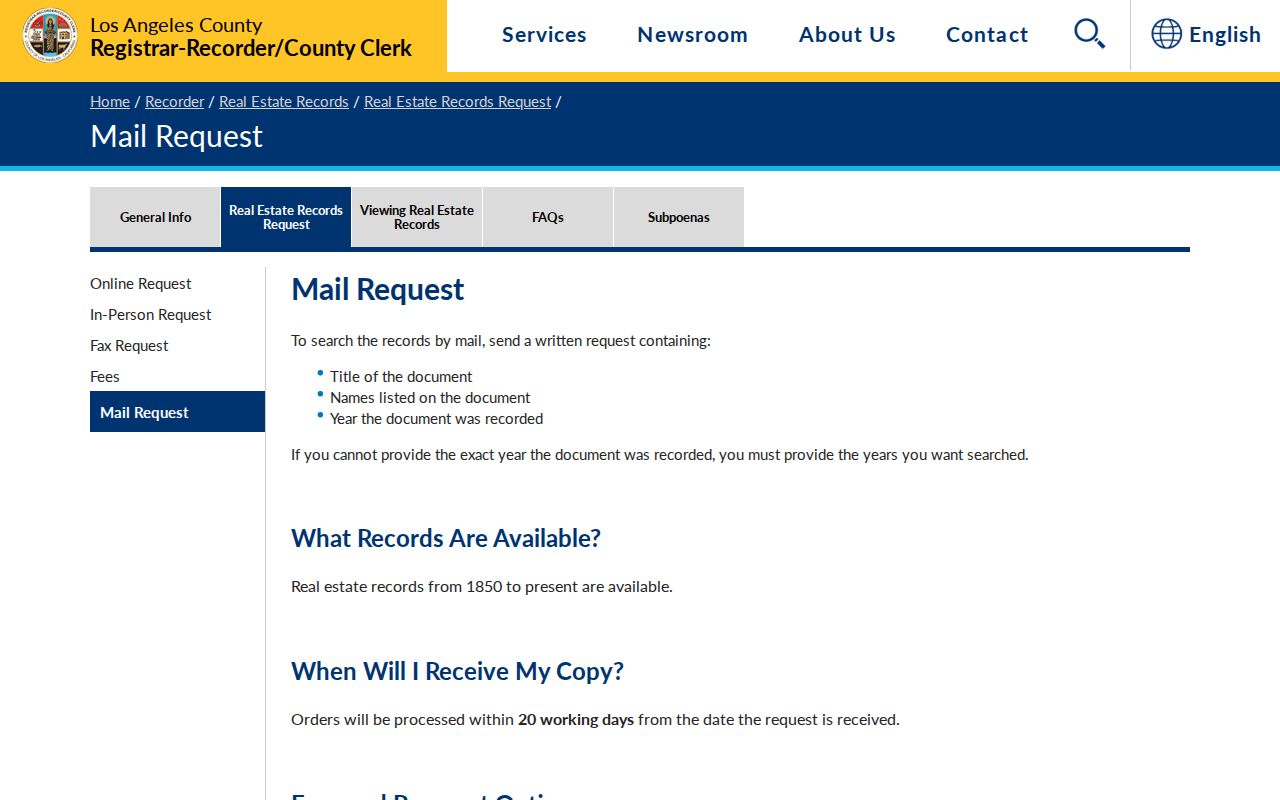
The mail form makes the backward-search rule visible: names and years are the index keys, not the street address.
Lakewood Previous Resident Norwalk Break
RR/CC’s physical organization is an important date marker. Records from 1851-1957 are reviewed on the lower level at 12400 Imperial Highway in Norwalk. Records from 1958-present are reviewed on the second floor. This is a floor and handling cutover, not an imaging cutoff or online search boundary. Neither range is offered as a public Internet name index.
Lakewood’s early mass build makes the boundary practical. Lakewood Park and related tracts expanded in the early 1950s, just before the 1954 incorporation. A chain may move from developer to first homeowner around 1950-53, then through later owners in the second-floor range. Use the county’s current copy and fee guidance before planning a visit.
The RR/CC fee page separates search, plain-copy, certified-copy, expedited, and payment details. Keep the source date in the research log because charges and office instructions can change.
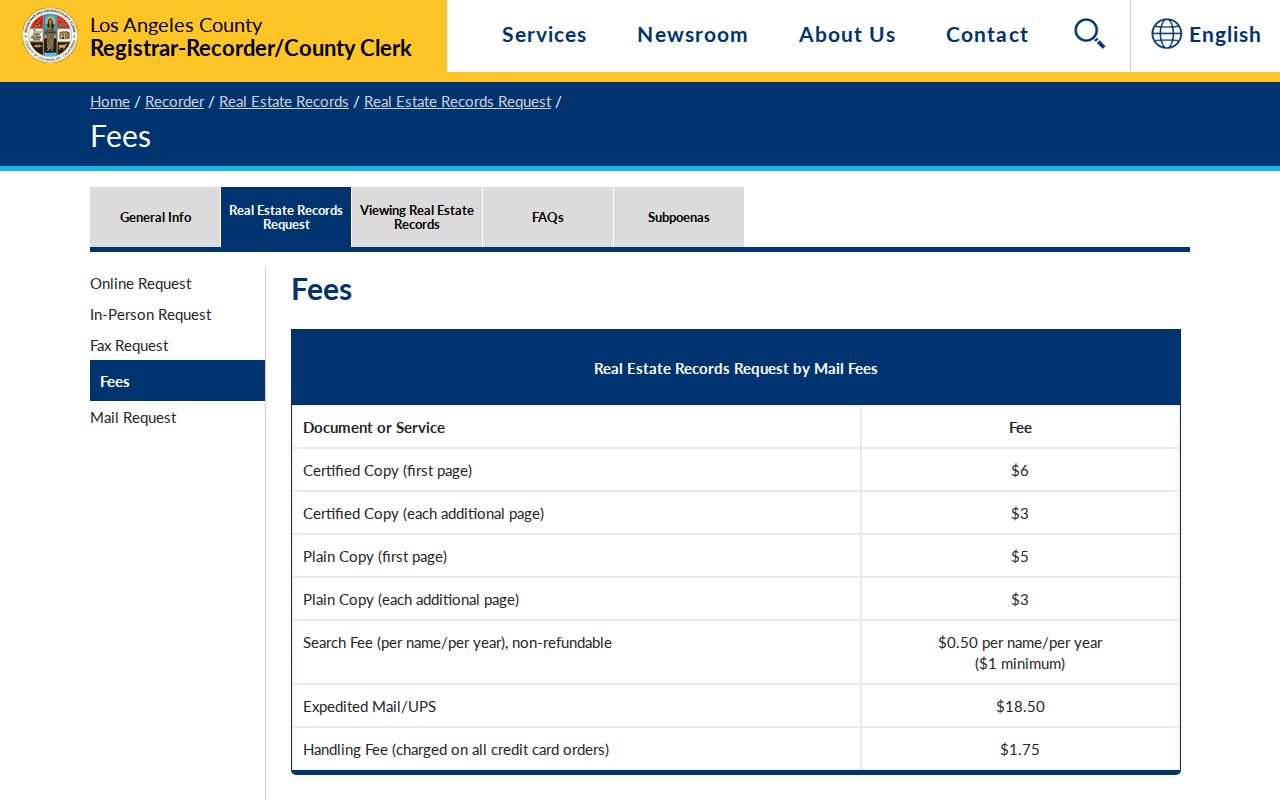
The fee information is useful when deciding whether to order one targeted instrument or inspect the index in person.
Lakewood Previous Residents First-Owner Story
Lakewood’s development pattern supplies a strong house-history hypothesis. Lakewood Village began in 1933. Lakewood Park built 17,500 homes over roughly 3,500 acres at about 50 houses a day. Mutual Homes dates to 1951, Carson Park to 1952-53, Imperial Estates to 1958-62, Sunshine Homes to 1961-63, and Lakewood Manor to 1962-63. Later tracts include Cherry Cove, Lakewood Shores, Ponderosa, and Westgate.
Those dates help choose a deed year and directory edition. They do not establish a person. A developer grantor may recur across thousands of parcels. The first recorded owner may not be the first listed occupant, and a cooperative-finance instrument may not read like a conventional sale. Pair the original tract map, assessor year-built field, first developer deed, and reverse directory entry to distinguish when the structure existed, who owned it, and who was listed there.
The Lakewood development history is the local date guide. The exact title and page still come from RR/CC, LAPL, or the city archive.
Lakewood Past Resident Households
Ownership and occupancy split at the directory shelf. LAPL ResCarta separates Historic City and Business & Phone Directories from Los Angeles Street-Reverse Directories. In a reverse volume, find the street and house number, record the listed subscriber, then inspect adjacent numbers and the closest earlier and later editions. The Lakewood city directory collections page describes the shelves and title verification, while this backward trail uses the result at one address.
Previous residents become more legible when a directory listing is compared with a deed date, census household, permit, or obituary rather than treated as a complete roster.
Pair directory years with the census carefully. The 1950 federal census is the latest released as of 2026 and gives a pre-boom baseline. The 1960 census becomes public in 2032. A directory can cover a year that falls between census dates, while a census captures a household on one enumeration date. Newspapers, school yearbooks, church books, and local-history captions can fill the personal context.
- Choose a directory year near the deed or permit date.
- Write down every adult listing, address, spouse, occupation mark, and telephone clue.
- Compare prior and later editions to bracket arrival or departure.
- Test a death or move with obituary, cemetery, probate, or later deed material.
Lakewood Previous Resident Estate Clues
Probate and obituary records often close a previous-resident trail. A probate petition can identify the decedent, petitioner, fiduciary, heirs, beneficiaries, and mailing addresses. A deed after death can show transfer of the property interest. A newspaper obituary may add relatives, a funeral home, school, church, or prior address. Verify each clue because an estate mailing address can belong to counsel or a fiduciary.
For a federal case involving a former resident, PACER’s Case Locator searches by party or case number and covers the Central District of California. Electronic access is $0.10 per page with a $3 document cap and quarterly billing waived when charges are $30 or less, as described in the research. Sealed filings remain unavailable. Federal court evidence is a legal-record clue, not a household directory.
The PACER gateway is the correct federal access channel when a county court search does not cover the case.
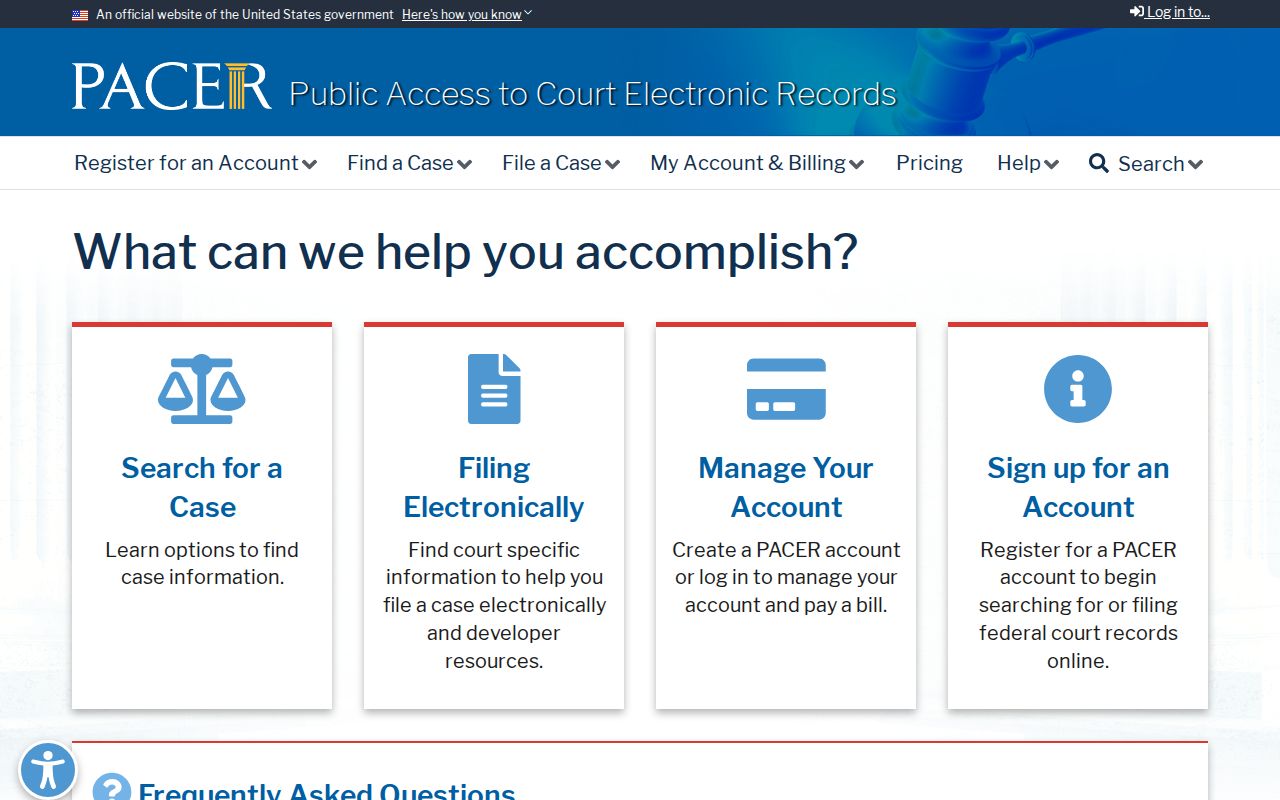
A federal search adds a separate court layer while leaving the parcel and family-history chain intact.
Lakewood Previous Residents Limits
Common names, trusts, corporations, repeated tract descriptions, quitclaims, interspousal transfers, and differing execution and recording dates can make a deed chain look smoother than it is. Compare AIN, legal description, tract, lot, cross street, and date at every step. Do not assume a seller moved to a deed’s return address. Do not call a developer a resident. Do not treat a permit applicant, directory subscriber, or probate mailing address as proof of residence.
Pre-1954 sources may call the place unincorporated Los Angeles County or use a Long Beach-area label. The research found no official source documenting a citywide Lakewood street-renumbering year or a confirmed Lakewood-specific Sanborn sheet run. Search tract and legal description when “Lakewood” fails, and mark an unverified address continuity rather than inventing a renumbering explanation.
House-history use. Previous residents research is appropriate for family history, preservation, and parcel history. Never use a deed or directory trail to stalk, harass, threaten, impersonate, or harm anyone.
Note: The cleanest backward trail keeps three columns: legal owner, listed occupant, and family or estate clue.