
Lakewood City Directory Shelves
The local directory record is a collection problem, not a single-volume lookup. The research does not identify an official exhaustive publisher-and-year run titled “Lakewood City Directory.” It does identify the collections that can hold Lakewood names, addresses, and neighborhood context. Confirm the title page, place statement, and year before treating a scanned or catalog result as California evidence.
| Collection | Years or scope | Where held | Access |
|---|---|---|---|
| Historic City and Business & Phone Directories | Title-dependent scanned years | LAPL ResCarta | Free date and collection search |
| Los Angeles Street-Reverse Directories | Title-dependent scanned years | LAPL ResCarta | Free street and house-number browse |
| Californiana city directories | 19th century and catalog-specific titles | Norwalk Library closed stacks | Catalog, request, or in-person help |
| California census schedules | 1850-1910 | Californiana, Norwalk | In person or research request |
| Lakewood city archive | Especially 1941 and 1950s onward civic files | City history website | Free online files |
| Federal census | Released through 1950; 1960 scheduled 2032 | NARA, partners, and libraries | Free or library access |
| Newspapers and yearbooks | Title and school dependent | Libraries, archives, and schools | Catalog, database, or in person |
The LAPL ResCarta collection is the first online shelf. Norwalk’s Californiana collection, the Lakewood archive, and regional partners fill the gaps when a scan does not include the needed year or place.
Lakewood Directory Search Modes
ResCarta’s Simple Search supplies From and To date boxes, Clear All, collection checkboxes, Browse Collections, and Browse Titles. Select All when the spelling is uncertain, then narrow to Historic City and Business & Phone Directories or Los Angeles Street-Reverse Directories. Browse Titles is often better than OCR when a surname is split, a scan is faint, or a place name is not indexed.
For an alphabetical Lakewood directory, search the person and inspect the full page. For a reverse volume, choose the year, open the street sequence, and scan the house number with its adjoining entries. Capture the title, volume, date, scan page, and neighboring page context. A search hit without a title page is only a lead.
| From / To | Date range for collection or title searching |
|---|---|
| Collection checkboxes | All, Historic City and Business & Phone Directories, or Los Angeles Street-Reverse Directories |
| Browse Collections | Collection-level view when a keyword fails |
| Browse Titles | Title-level view for place, publisher, and volume verification |
| Scanned page | Image and OCR context to cite after a hit |
Open the LAPL ResCarta collection before trusting a date or title from a general catalog result.
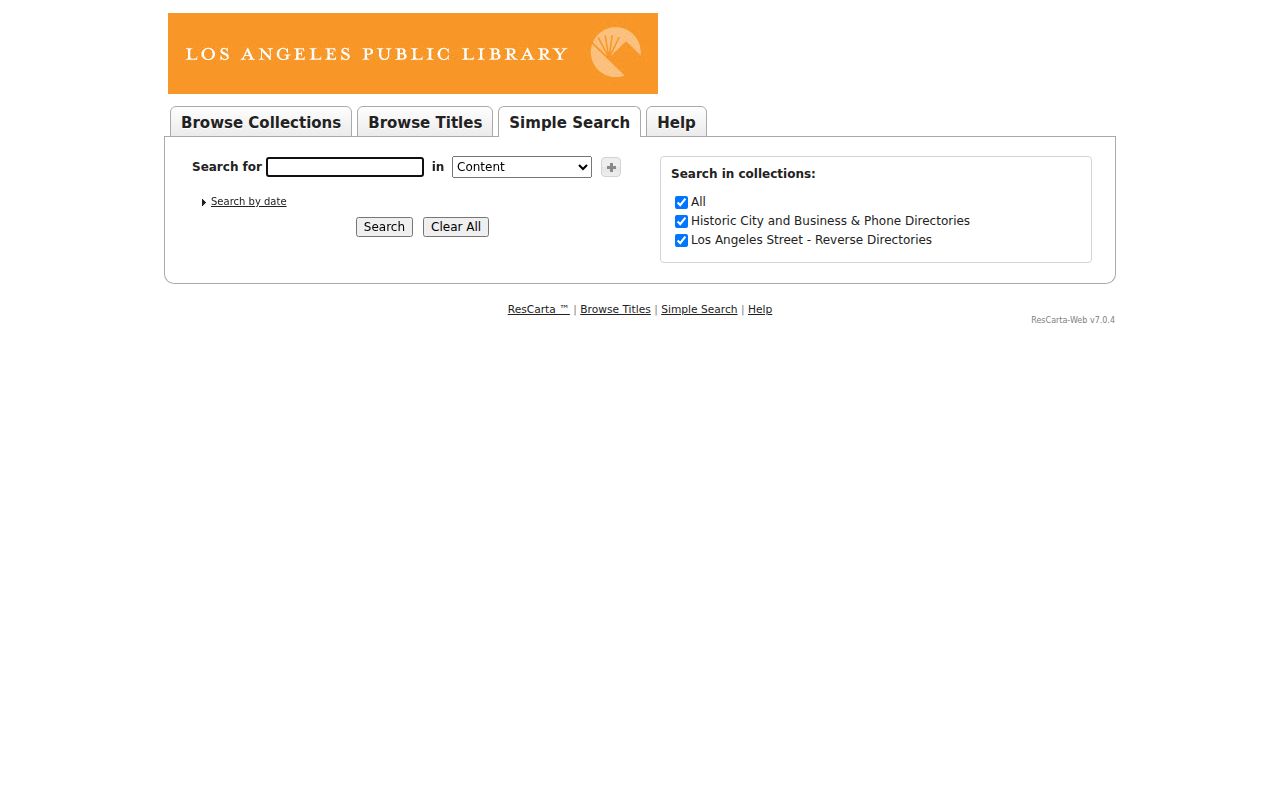
The ResCarta interface separates historic alphabetical material from reverse street material, which prevents a name search from being mistaken for a complete address search.
Reading a Lakewood Directory Entry
A Lakewood city directory entry is a time-stamped clue. Alphabetical pages commonly show surname, given name or initial, spouse in parentheses, occupation or workplace abbreviation, and home address. Business pages may show firm, category, address, and telephone. Reverse pages sort by street and house number and may show a listed occupant or subscriber. The volume’s opening pages explain its own abbreviations and omissions.
“r” may mean resides and “h” may mean house, but the key for that volume controls. A directory can omit people who declined a canvass, lacked a telephone, moved between editions, or fell outside the title’s coverage. The address can lag a move. A directory listing therefore complements deeds and assessor data rather than replacing them.
- Name, initial, and surname spelling, including OCR variants.
- Spouse or household link where the volume prints one.
- Occupation or business abbreviation as a historical identity clue.
- Home address, street sequence, or telephone subscriber detail.
- Title page, publisher, place, year, scan page, and abbreviation key.
- Reverse directory
- An address-first volume arranged by street and house number.
- Householder index
- A listing centered on a named adult or primary subscriber, not every household member.
- Abbreviation key
- The volume’s own guide to marks such as resides, house, or widow.
- OCR
- Machine-read text that can confuse letters, initials, and names; verify against the scanned page.
Note: A clear scan still needs its title page because the same surname or place label can occur in another region.
Lakewood Directory Namesake Trap
Search results for “Lakewood city directories” can surface the historical society inventory for Lakewood, Ohio, including Cleveland-area runs from 1949-1963. That material is not evidence about Lakewood, California. The namesake problem is especially serious when an online catalog gives a person, year, and city-directory title without showing the title page or place statement.
Require three checks before using a hit: the volume names Southern California or Los Angeles-area coverage, the address fits Lakewood geography, and a second source supports the person or parcel. For pre-1954 residents, search Los Angeles County, Long Beach-adjacent communities, township, tract, and subdivision terms. Lakewood Village began in 1933, and the city did not incorporate until 1954.
Place check. A catalog title that says only “Lakewood” is incomplete evidence. Verify the place on the scanned title page before copying a name into a California family history.
Lakewood Californiana Directory Shelf
The LA County Library Californiana Collection at Norwalk Library, 12350 Imperial Highway, is a closed-stack research shelf with more than 24,000 books, more than 200 periodical and newspaper titles, California census schedules from 1850-1910, the Los Angeles Star from 1851-1879, nineteenth-century directories, and government histories. A closed stack means a librarian or staff member retrieves the item. Use the catalog, Ask a Librarian, public computers, and licensed genealogy resources before visiting.
Angelo M. Iacoboni Library and George Nye Jr. Library add catalogs, yearbooks, newspapers, local files, public computers, and librarian referral. Nye reopened after renovation on November 12, 2024. For older Lakewood material, CSU Long Beach special collections and the Historical Society of Long Beach matter because pre-incorporation records may be cataloged under a regional place rather than the modern city.
The LA County Library local-history collection is the best starting description of the Californiana shelf and its access limits.
The closed-stack collection supplies a physical fallback when a Lakewood volume scan stops short of the needed title or year.
Tracing Lakewood Directory Households
Directory years work best as a sequence. Establish the address through the assessor, deed, or permit record. Select the closest reverse-directory year, write down every adult listing, then inspect the prior and next available volumes. Track street number, spouse, initial, occupation abbreviation, telephone, and any move. Pair the directory with deeds to separate owner from occupant, and with probate or obituary material when a person disappears.
- Set the modern parcel and legal description first.
- Choose a directory year close to the known event or address date.
- Read the full page, title page, and abbreviation key.
- Compare the same street and house number in the nearest earlier and later volumes.
- Use the 1950 census for a pre-boom baseline; the 1960 census is not released until 2032.
- Test departures with deeds, newspapers, death records, probate, or later directory entries.
Lakewood’s mass postwar development creates a useful break. Lakewood Park’s 17,500 houses were built over roughly 3,500 acres at about 50 houses a day. The first owner may appear in a developer deed around the early 1950s, while the first listed occupant appears in a later directory. Those are related but distinct events.
A directory disappearance can mean a move, death, omission, nontelephone household, or title gap. The strongest answer comes from two or three record types, not from assuming that absence is proof of departure.
Lakewood's Postwar Directory Story
Lakewood’s history changes how a city directory should be read. Lakewood Village began as a 1933 development, while Lakewood Park and related tracts expanded sharply after 1950. Mutual Homes dates to 1951, Carson Park to 1952-53, Imperial Estates to 1958-62, Sunshine Homes to 1961-63, Lakewood Manor to 1962-63, and later communities include Cherry Cove, Lakewood Shores, Ponderosa, and Westgate.
Those dates guide a search without creating a false directory run. A claimed 1940 Lakewood Shores entry is chronologically suspect. A 1952 Lakewood Park first-owner trail is plausible. Carson Park requires a boundary check because much of the area south of Carson Street joined Long Beach in 1953 while the northern part entered Lakewood in 1954. Use tract, lot, parcel, and postal clues together.
The city’s Lakewood Story supplies the development dates and neighborhood history that make a directory year meaningful.
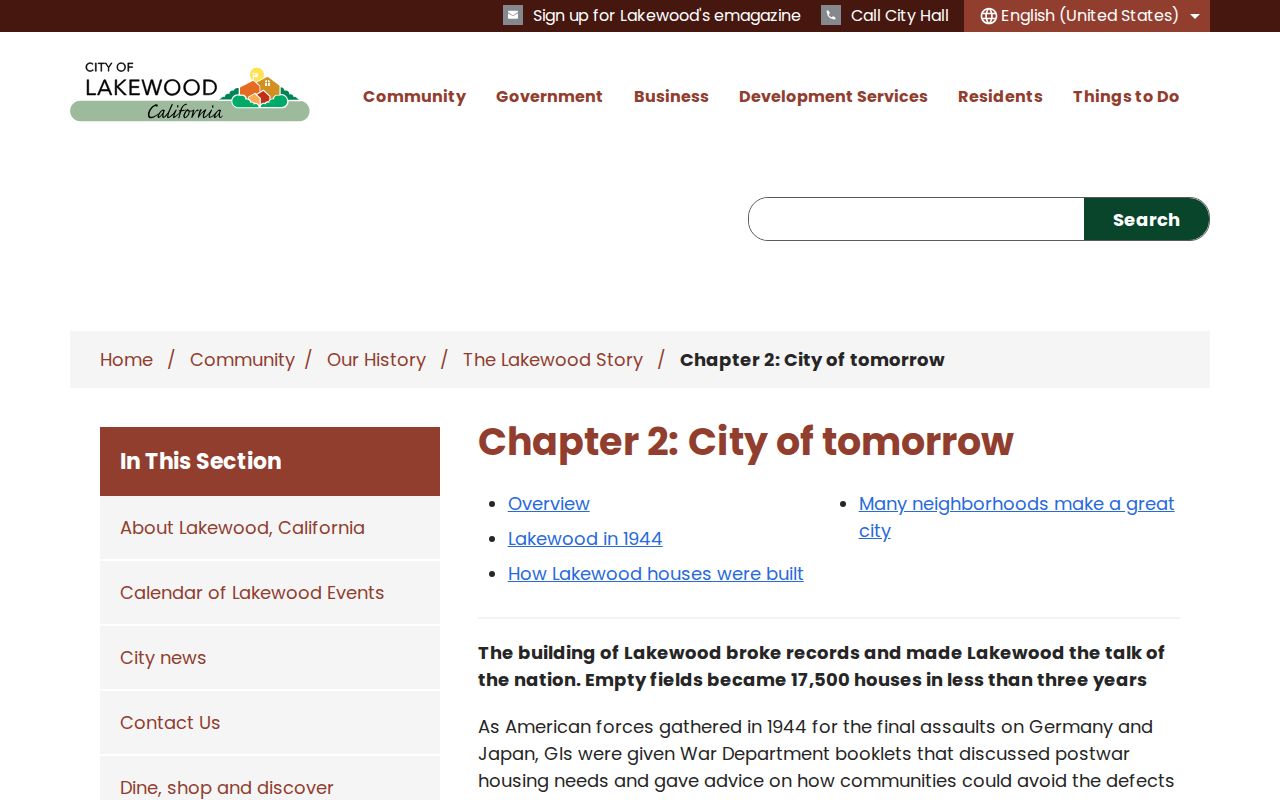
Neighborhood history helps test whether a directory title, address, and development phase can belong together.
Lakewood Archive Directory Clues
The city’s historical documents archive holds original tract maps and primary civic-history files. These documents can supply a subdivision name, date, boundary, or public project reference that a directory search lacks. The City Clerk and city history pages are useful for municipal files, but deeds, birth certificates, and marriage licenses remain county records. Keep the creator and custodian separate when requesting a copy.
Lakewood’s contract-service structure explains the split. County sheriff, court, recorder, assessor, and elections records sit beside a lean municipal record set. A name in a city photo caption can guide a directory or obituary search, yet the caption does not prove residence. The city’s March 27, 2025 artifact call sought identified family, school, business, faith-community, Chamber, and resident-connected material, while anonymous or uncaptioned items were not accepted.
The Lakewood historical documents archive provides the tract and civic source layer.
Archive material can establish when a tract or civic institution existed, then send the search back to the right directory year and place.
Lakewood Newspaper Directory Clues
When a city directory gives a name and address, newspapers and yearbooks can add family, school, civic, or neighborhood context. Search surnames with a street, tract, school, church, civic group, or Lakewood Center term. LA County Library databases, California Digital Newspaper Collection, Chronicling America, school archives, and library catalogs vary by title and access channel. A licensed database may require a library card or an in-library computer.
Funeral-home and newspaper obituaries can connect relatives and dates, but user-submitted material can contain errors. Corroborate with death, probate, deed-after-death, or cemetery records. Church, American Legion, veterans, fraternal, and civic anniversary books may hold photographs and family names. Current private membership lists are not public, even when an organization has a public contact.
For a present-day identity check after a directory find, use the Lakewood resident lookup to compare the name with modern court, vital, parcel, or license records. The historical entry remains evidence of a listing at a time, not proof of current residence.
Note: The best household trail pairs a directory page with a parcel clue, an event record, and a second date rather than relying on one scan.